



Ventilated & Downdraft Autopsy Tables
A ventilated (downdraft) autopsy table captures formaldehyde and other vapors at the work surface and sends them to exhaust before they reach the prosector's breathing zone. This page compares the vented autopsy and dissection tables we sell, with the specifications published on each product page and their current prices, and explains what to plan before a ventilated table is installed.
Ventilated autopsy table models
| Model | Ventilation | Surface and drainage | Cover / size | Price |
|---|---|---|---|---|
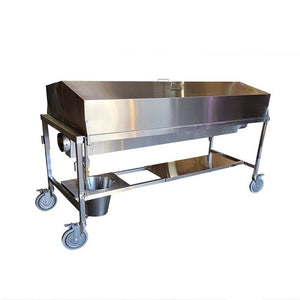
| USPE-DT-V Vented Downdraft Dissection Table with Cover | Downdraft or backdraft extraction through the work surface; ducted to building exhaust | 304 stainless, seamless dished top, perimeter drainage to a single outlet | Lift-open stainless cover for specimen storage | $7,909.11 |
| USPE-1035-06DT-V Vented Covered Autopsy Dissection Table | Backdraft / downdraft, integrated exhaust capture inside the cover | 304 stainless dissection-grade surface, integrated perimeter waste channel | Covered design | $8,841.20 |
| USPE-AN-RV86 Raised-Side Ventilated Dissection Table | Ventilated, raised sides | 304 stainless | 86 × 32 in planning envelope, 32–38 in deck-height target, manual crank or powered lift request | Quote |
| USPE-AN-HY88 Hydraulic Dissection Table with Exhaust Chamber | Below-deck exhaust chamber with perimeter extraction panels | 304 stainless | 88 × 32 in planning envelope, 34–47 in deck-height target, hydraulic lift | Quote |
For surgical pathology specimens rather than whole-body work, see the USPE-GS-DD Downdraft Pathology Grossing Station ($12,789.99). For animal post-mortems, see veterinary necropsy tables.
Downdraft vs backdraft vs a standard autopsy table
Downdraft pulls vapor down through perforations or slots in the work surface, so capture happens directly under the tissue. Backdraft pulls vapor horizontally to slots at the back edge, which leaves the top fully open. A standard autopsy table, such as the autopsy table with sink, relies on room ventilation alone. Choose a ventilated table when fixed tissue, embalmed or decomposed remains, or teaching sessions keep people at the table for long periods.
What to plan before installing a ventilated table
- Exhaust route: where the duct leaves the table and how it reaches the building exhaust or a dedicated fan.
- Airflow and static pressure: the USPE product pages ask you to confirm required airflow, available static pressure, balancing and commissioning with the facility before ordering.
- Make-up air: the room must supply as much air as the table and room exhaust remove, or capture performance falls.
- Drainage and water: perimeter drainage runs to a single outlet; align it with the floor drain and plan water for rinsing.
- Air monitoring: confirm exposure with formaldehyde monitoring after installation; ventilation is an engineering control, not proof of compliance on its own.
Formaldehyde limits that drive the decision
OSHA's formaldehyde standard (29 CFR 1910.1048) sets a permissible exposure limit of 0.75 ppm (8-hour TWA), a 2 ppm short-term limit and a 0.5 ppm action level. For how those limits apply in the autopsy room, see our OSHA formaldehyde guide for autopsy tables.
Related pages
- All autopsy tables, including pedestal, L-shaped and roller models
- Hydraulic and elevating autopsy tables
- Pathology dissection tables and cadaver dissection tables
- Autopsy table buying guide
Downdraft autopsy table FAQ
How does a downdraft autopsy table work?
Exhaust air is drawn through or around the work surface, downward (downdraft) or toward the back of the table (backdraft), so formaldehyde and other vapors are pulled away from the prosector's breathing zone and into the building exhaust instead of rising past the face.
How much does a downdraft autopsy table cost?
The USPE Vented Downdraft Dissection Table with Cover (USPE-DT-V) is listed at $7,909.11 and the Vented Covered Autopsy Dissection Table (USPE-1035-06DT-V) at $8,841.20. Raised-side ventilated and hydraulic exhaust-chamber dissection tables are configured and quoted per project.
What is the difference between downdraft and backdraft?
Downdraft pulls vapor below the work surface; backdraft pulls it horizontally toward slots at the back of the table. The USPE-1035-06DT-V uses an integrated capture channel inside the cover that does both.
Can a ventilated autopsy table connect to our existing exhaust?
The USPE-DT-V product page states it can connect to existing exhaust. Before ordering, have your mechanical engineer confirm the exhaust route, available static pressure, required airflow and balancing for the room.
What are the OSHA formaldehyde exposure limits?
Under OSHA's formaldehyde standard (29 CFR 1910.1048) the permissible exposure limit is 0.75 ppm as an 8-hour time-weighted average, the short-term limit is 2 ppm over 15 minutes, and the action level is 0.5 ppm. Ventilation at the table is one of the engineering controls used to stay under those limits; actual exposure must be confirmed by air monitoring.


