



R-404A Pressure-Temperature Chart and 2026 A2L Walk-In Mortuary Cooler Guide
A verified R-404A pressure-temperature chart (bubble and dew, psig) plus EPA's 2026 Technology Transitions rule — what it means for servicing an existing mortuary walk-in versus specifying a new one.

If you are charging, diagnosing, or planning a replacement on an existing R-404A mortuary walk-in, start with the pressure-temperature chart below, then use the 2026 EPA Technology Transitions dates to decide whether you are servicing that system or specifying a new one. The chart gives saturated R-404A pressures in psig at sea level. The rule discussion covers what EPA actually published — and what it does not automatically require of every funeral-home walk-in.
Key takeaways
- R-404A is a zeotropic blend: use the vapor (dew) column for superheat and the liquid (bubble) column for subcooling. The two pressures are close but not the same.
- Highlighted rows at 34°F, 36°F and 38°F, and at −10°F and 0°F, are saturated temperatures on the chart — not automatic suction or head setpoints for a box holding those air temperatures.
- EPA finalized a Technology Transitions reconsideration on May 21, 2026, effective July 27, 2026. The GWP limits in that rule apply to listed subsectors (including cold storage warehouses and retail food remote condensing units). Confirm how a mortuary or morgue walk-in is classified before treating those dates as a mandatory replacement deadline.
- Existing R-404A systems are generally serviced rather than treated as new installations. New commercial walk-in equipment is increasingly offered with lower-GWP A2L blends such as R-454C, R-455A and R-454A, which are not generic drop-ins and are not the same safety class as R-290 (A3).
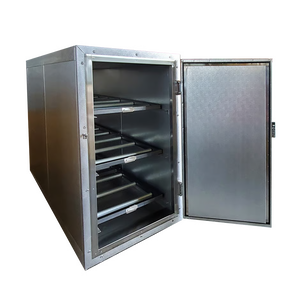
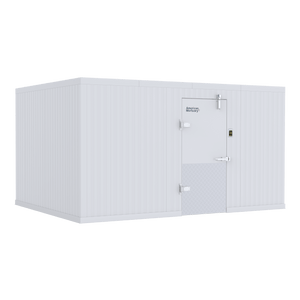
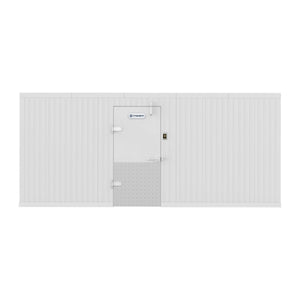
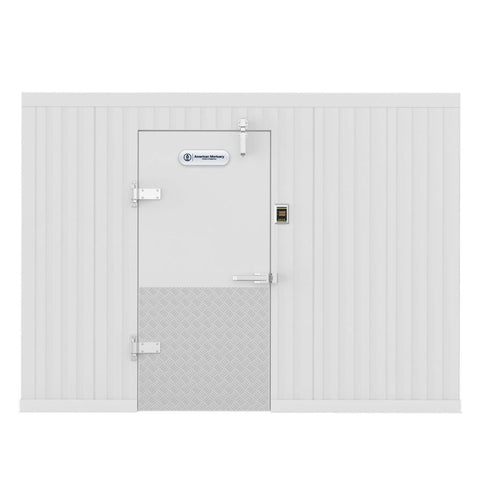
- A standard 8×10 walk-in mortuary refrigerator lists at $10,800.57 (SKU AMC-0810-LH-8). The smaller 6×8 lists at $8,825.00 (SKU AMC-0608-RH-6). Confirm the refrigeration package and refrigerant on the configuration you are ordering.
R-404A pressure-temperature chart (psig, sea level)
Values below are saturated pressures in psig at sea level. Liquid (bubble) pressures match the Chemours/DuPont Suva R-404A column; liquid and vapor (dew) columns follow the Arkema Forane 404A pressure-temperature chart (the 100°F dew value of 234.6 psig is from that manufacturer chart). R-404A has a small glide, so bubble and dew are listed separately.
| Temperature (°F) | Liquid / bubble (psig) | Vapor / dew (psig) |
|---|---|---|
| -40 | 4.9 | 4.3 |
| -30 | 10.3 | 9.6 |
| -20 | 16.8 | 16.0 |
| -10 (common walk-in freezer box temp) | 24.6 | 23.6 |
| 0 (common walk-in freezer box temp) | 33.7 | 32.6 |
| 10 | 44.3 | 43.1 |
| 20 | 56.6 | 55.3 |
| 30 | 70.7 | 69.3 |
| 34 (common mortuary cooler box temp) | 77.0 | 75.5 |
| 36 (common mortuary cooler box temp) | 80.2 | 78.7 |
| 38 (common mortuary cooler box temp) | 83.5 | 82.0 |
| 40 | 86.9 | 85.4 |
| 50 | 105.3 | 103.6 |
| 60 | 126.0 | 124.2 |
| 70 | 149.3 | 147.4 |
| 80 | 175.4 | 173.4 |
| 90 | 204.5 | 202.4 |
| 100 | 236.8 | 234.6 |
| 110 | 272.6 | 270.4 |
| 120 | 312.1 | 309.9 |
| 130 | 355.7 | 353.6 |
Using the two columns. Read a suction-line (vapor) pressure against the dew column to get saturated suction temperature, then subtract that from the actual suction-line temperature to get superheat. Read a liquid-line pressure against the bubble column to get saturated liquid temperature, then subtract the actual liquid-line temperature to get subcooling. Do not average the two columns, and do not use a chart printed in inches of mercury or kPa interchangeably with this psig table.
About the highlighted 34°F–38°F and −10°F–0°F rows. Those are common mortuary walk-in cooler and freezer box temperatures, shown so you can find them quickly on the chart. They are not published factory suction or head targets for a particular American Mortuary Coolers walk-in. Evaporator temperature is typically below box temperature, and condensing temperature tracks the condenser and ambient conditions. Convert the pressures on the gauges in front of you, then follow the equipment manufacturer's superheat and subcooling guidance.
EPA AIM Act and the 2026 Technology Transitions rule
The American Innovation and Manufacturing (AIM) Act of 2020 is the federal law behind the U.S. hydrofluorocarbon (HFC) phasedown. That phasedown limits production and consumption of HFCs, including the R-404A used in many existing commercial and mortuary walk-in systems, so supply and price can change even when a system stays in place.
Separately, EPA's Technology Transitions program restricts the use of higher-GWP HFCs in listed sectors and subsectors. On May 21, 2026, EPA finalized a reconsideration of those restrictions. The final rule was published in the Federal Register on May 26, 2026, and is effective July 27, 2026. Use EPA's current HFC Restrictions by Sector table and the rule text in 40 CFR Part 84, Subpart B for compliance — not an outdated fact sheet. (EPA's October 2023 Technology Transitions fact sheet, even when hosted in a May 2026 file, states that it has not been updated to reflect this reconsideration.)
From that official sector table, two subsectors that often come up in commercial walk-in discussions are:
- Cold storage warehouses: a 700 GWP limit beginning July 27, 2026, then on January 1, 2032 a 150 GWP limit for systems with 200 lb or more of charge (excluding the high-temperature side of a cascade system), or a 300 GWP limit for systems with less than 200 lb of charge and for the high-temperature side of a cascade system.
- Retail food — remote condensing units: a 1,400 GWP limit beginning July 27, 2026, then on January 1, 2032 the same 150 / 300 GWP split by charge size and cascade configuration.
R-404A sits well above those GWP limits, so a new installation in a listed subsector would not use it once the applicable date and limit apply. That is not the same thing as a nationwide order to scrap every existing R-404A mortuary walk-in on July 27, 2026. Funeral homes, crematories, hospital morgues and medical examiner offices should confirm how their specific system is classified. A mortuary walk-in is not automatically a “retail food” remote condensing unit or a “cold storage warehouse” just because it is a walk-in box.
EPA's Technology Transitions restrictions are written around new products and new system installations in those listed subsectors. Repairing an existing, already-installed system is generally treated differently from installing a new one; confirm the current regulatory text and your contractor's reading of it before a major repair or a refrigerant change.
New commercial walk-in coolers and freezers are increasingly offered with lower-GWP A2L refrigerants. An Oak Ridge National Laboratory review of next-generation walk-in refrigerants identifies R-454A, R-454C and R-455A as efficient options for smaller remote walk-ins, and R-454C and R-455A for smaller self-contained walk-ins. Those blends are ASHRAE A2L (mildly flammable). Designing, installing and servicing that equipment is addressed in standards such as UL 60335-2-89 and ASHRAE 15. This guide does not claim that a particular American Mortuary Coolers walk-in is listed to those standards or ships with a specific A2L charge — confirm the refrigerant and listing on the quotation. And do not confuse A2L blends with R-290, which is an A3 (higher flammability) refrigerant, not an A2L.
For a broader primer on A2L refrigerants in this industry, see our A2L and low-GWP refrigerants guide for mortuary coolers and A2L refrigerants explained for funeral homes and morgues.
Servicing an existing R-404A walk-in vs. installing a new system
| Servicing an existing R-404A walk-in | Installing a new walk-in system | |
|---|---|---|
| Typical goal | Keep a working box and refrigeration circuit in service. | Specify a new box and/or a new condensing unit or package under current rules. |
| Refrigerant | Continue with the refrigerant the system was built and charged for. Recover and recharge only with a certified technician and compatible recovery equipment. | Confirm the factory refrigerant for the exact condensing unit or package. New commercial walk-in equipment is increasingly offered with lower-GWP A2L blends such as R-454C, R-455A and R-454A — not as generic drop-in charges for an old R-404A circuit. |
| What the 2026 rule is aimed at | Technology Transitions GWP limits are written for new products and new installations in listed subsectors. An existing system is typically maintained rather than treated as a new installation on July 27, 2026. The AIM Act phasedown can still affect R-404A availability and cost. | A new installation in a listed subsector must meet the GWP limit that applies on the relevant date (July 27, 2026 and, later, January 1, 2032 in the examples above). Confirm whether the mortuary or morgue project is in a listed subsector before you write the specification. |
| Safety and tools | Use an R-404A P-T chart, Section 608-certified recovery, and OEM parts that match the existing unit. | A2L (mildly flammable) refrigerants require tools, charge limits, and installation practices consistent with UL 60335-2-89 and ASHRAE 15, plus technicians trained for A2L work. R-290 is A3, not A2L. |
| Examples from the current catalog | 50 lb refrigerant recovery tank at $144.99; OEM parts such as the Heatcraft 24703701 crankcase heater (SKU MMCP-HC-24703701, $91.50); and listed R-404A condensing units such as the Turbo Air TS010MR404A2 1 HP cooler unit (SKU TS010MR404A2, $3,442.82). | A 6×8 walk-in mortuary refrigerator lists at $8,825.00 (SKU AMC-0608-RH-6). An 8×10 walk-in mortuary refrigerator lists at $10,800.57 (SKU AMC-0810-LH-8). That 8×10 figure is the list price for that size; the smaller 6×8 lists lower. An 8×10 walk-in mortuary freezer lists at $15,055.41 (SKU AMC-0810F-RH-8). Confirm the refrigeration package and refrigerant on the quoted configuration. |
Featured products

SKU AMC-0608-RH-6
$8,825.00

SKU AMC-0810-LH-8
$10,800.57

SKU AMC-0810F-RH-8
$15,055.41

$144.99

SKU TS010MR404A2
$3,442.82

SKU MMCP-HC-24703701
$91.50
System layout — remote condensing unit versus a packaged top-mount, cooler versus freezer, and how the evaporator is matched — is covered in more detail in Walk-In Cooler Refrigeration Systems Explained and in Walk-In Cooler vs. Walk-In Freezer. For recovery practice and related cylinders, see the refrigerant and recovery equipment guide.
Walk-in coolers, freezers, and service equipment in the current catalog
The products below are live catalog listings with current prices. An 8×8 walk-in mortuary refrigerator is also listed at $10,238.00 (SKU AMC-0808-RH), and a 6×8 walk-in mortuary freezer is listed at $13,975.49 (SKU AMC-0608F-RH-6). Refrigerant type and condensing-unit selection are configuration-specific; we do not treat the box price as a claim about which refrigerant ships in a given unit.
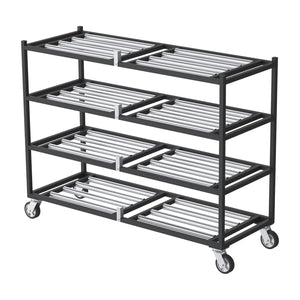
For a sense of how a larger walk-in and rack system goes together in the field, watch the 100-body cooler and rack system install from AMERICAN MORTUARY EQUIPMENT™:
Frequently asked questions
What is an R-404A pressure-temperature chart used for?
A P-T chart converts a gauge pressure, in psig at sea level, to the saturated temperature of R-404A — and the other way around. Technicians use it to find saturated suction temperature and saturated condensing (liquid) temperature, then calculate superheat and subcooling. It is a refrigerant property table, not a substitute for the equipment manufacturer's operating instructions.
Why does R-404A have two pressures — bubble and dew — at the same temperature?
R-404A is a zeotropic blend, so it has a small temperature glide. The liquid (bubble) pressure is the saturation pressure of the liquid, and the vapor (dew) pressure is the saturation pressure of the vapor. Use dew/vapor values when converting a suction-line (vapor) pressure for superheat, and bubble/liquid values when converting a liquid-line pressure for subcooling. The two columns are close, but they are not identical.
Can I read suction pressure directly from the 34°F–38°F or −10°F–0°F rows?
Not as a shortcut for box temperature. Those highlighted rows are the saturated pressures at those temperatures. A mortuary walk-in cooler holding 34°F–38°F, or a freezer holding about −10°F–0°F, has a box air temperature — not the saturated suction temperature. The evaporator typically runs colder than the box, and condensing temperature depends on ambient conditions and the condenser. Convert the pressures you actually measure on the gauges, then apply superheat and subcooling the way the system is designed.
Does EPA's July 27, 2026 Technology Transitions rule require every funeral home to replace an existing R-404A walk-in?
No automatic replacement requirement is stated that way. EPA finalized a reconsideration of the Technology Transitions rule on May 21, 2026; the rule is effective July 27, 2026. The GWP limits and installation dates in EPA's sector table apply to listed subsectors — for example, cold storage warehouses (700 GWP beginning July 27, 2026, then 150 or 300 on January 1, 2032, depending on charge size and configuration) and retail food remote condensing units (1,400 GWP beginning July 27, 2026, then 150 or 300 on January 1, 2032). Whether a given mortuary or morgue walk-in falls into a listed subsector depends on the system type and use. Confirm classification with the equipment manufacturer and a qualified refrigeration contractor, and read the official table rather than assuming a food-retail date applies automatically. Existing systems are generally serviced rather than treated as new installations. The broader AIM Act HFC phasedown still affects R-404A production, supply, and cost.
What refrigerants are being used in new commercial walk-in systems instead of R-404A?
Lower-GWP A2L (mildly flammable) blends such as R-454C, R-455A, and R-454A are widely discussed for new commercial walk-in coolers and freezers, especially smaller remote and self-contained systems. They are not generic drop-in charges for an existing R-404A rack or condensing unit. A2L equipment and installation practices are addressed in standards such as UL 60335-2-89 and ASHRAE 15. R-290 (propane) is a different safety class — ASHRAE A3, not A2L — and should not be described as an A2L option. Confirm the factory refrigerant on the exact condensing unit or package you are quoting; American Mortuary Coolers walk-in listings in this guide are shown with current box prices, and the refrigeration charge should be confirmed for the configuration being ordered.
Related guides
- A2L & Low-GWP Refrigerants for Mortuary Coolers: The 2026 AIM Act Guide
- A2L Refrigerants Explained: What 2026 Refrigerant Rules Mean for Funeral Homes and Morgues
- Walk-In Cooler Refrigeration Systems Explained
- Walk-In Cooler vs. Walk-In Freezer: Key Differences
- Walk-In Cooler Temperature Requirements by Industry
- Refrigerant & Recovery Equipment Guide for Mortuary Cooler Technicians
Resources
Product video
- 100 Body Cooler & Rack System Install (YouTube, AMERICAN MORTUARY EQUIPMENT™)
Related products
- 6x8 Walk-In Mortuary Refrigerator — SKU AMC-0608-RH-6, $8,825.00
- 8x10 Walk-In Mortuary Refrigerator — SKU AMC-0810-LH-8, $10,800.57
- 8x10 Walk-In Mortuary Freezer — SKU AMC-0810F-RH-8, $15,055.41
- 50 lb Refrigerant Recovery Tank — $144.99
- Turbo Air TS010MR404A2 1 HP Scroll Walk-In Cooler Condensing Unit — SKU TS010MR404A2, $3,442.82
- Heatcraft 24703701 Crankcase Heater, Scroll Compressor, 240V, 80W — SKU MMCP-HC-24703701, $91.50
Official references
- EPA: Technology Transitions HFC Restrictions by Sector (current GWP limits and installation dates, including the July 27, 2026 and January 1, 2032 rows cited above)
- Federal Register: Technology Transitions reconsideration (published May 26, 2026; effective July 27, 2026)
- EPA Summary of Action fact sheet (final rule signed May 21, 2026)
- Oak Ridge National Laboratory: next-generation refrigerants in U.S. walk-in coolers and freezers (R-454A, R-454C, R-455A discussion)
- Arkema Forane 404A Pressure Temperature Chart (bubble and dew, psig)
- Chemours/DuPont Suva pressure-temperature chart (R-404A saturated column used for the liquid/bubble values)
See all videos on the AMERICAN MORTUARY EQUIPMENT™ YouTube channel
