




Why Your Mortuary Cooler Smells and How to Fix It Fast

A mortuary cooler should smell like a clean, cold room. When an odor appears or keeps coming back, it means something has changed. Remains may be leaking, residue may be hidden in the box, the drain or evaporator may be wet and dirty, or the cooler may no longer be holding temperature. In a mortuary, the last cause is the most serious, because warmer storage speeds decomposition for every case in the room. This guide walks through the common causes in order, with quick checks and fixes for each.
Key takeaways
- In a mortuary, the most common source is a case that is leaking.
- Odor that stays after the box is empty usually comes from residue.
- The evaporator removes moisture from the air, and that water drains out through a pan and drain line.
- EPA states plainly that the key to mold control is moisture control, and that mold cleanup must be paired with fixing the water problem or it will return (EPA mold guide).
- A torn, flattened or hard gasket lets warm, humid air into the box.
For case handling, pouch selection and leak cleanup, see the companion guide, Decomposition Odor in Mortuary Coolers: Containment, Cleanup and Control.
Check the temperature first
Before you clean anything, read the cooler's display and confirm it with a separate thermometer. The World Health Organization identifies refrigeration between 2°C and 4°C (about 36°F to 39°F) as the best option for storing the dead (WHO field manual). Virginia, for example, requires refrigeration at no more than approximately 40°F for bodies held over 48 hours without embalming (Va. Code § 54.1-2811.1).
If the box is warm, treat it as an equipment problem first. Odor will keep getting worse until the cooler is holding temperature again. Common reasons for drift are covered in compressor, temperature and ice problems and morgue cooler temperature standards.
Quick diagnosis table
| What you notice | Likely cause | First fix |
|---|---|---|
| Strong decomposition odor, normal temperature | Leaking pouch or a decomposed case | Find the case, re-pouch it and clean the area |
| Odor stays after cases are removed | Residue on trays, rails, floor seams or gaskets | Clean, disinfect and dry the hidden areas |
| Musty smell, water on the floor | Clogged condensate drain or drain pan | Clear the drain and clean the pan |
| Musty smell from the fan area, humid air | Dirty evaporator coil or fan housing | Schedule a coil and fan cleaning |
| Frost or sweating near the door | Worn or torn door gasket, door not closing | Inspect and replace the gasket |
| Rising temperature, odor getting worse | Controller, sensor, fan or refrigeration fault | Call a refrigeration technician |
Leaking pouches and hidden cases
In a mortuary, the most common source is a case that is leaking. Check every pouch for an open zipper, a split seam or fluid on the outside, and look under trays and racks. Re-pouch any leaking case in a heavier bag. Our body bags and disaster pouches include heavy-duty PVC and chlorine-free options. If fluid has reached a surface, follow the leak cleanup steps in the decomposition odor guide. OSHA requires contaminated surfaces to be decontaminated with an appropriate disinfectant immediately or as soon as feasible after a spill (OSHA 29 CFR 1910.1030).
Residue in trays, seams and floors
Odor that stays after the box is empty usually comes from residue. Fluid runs into tray rails, under racks, along floor-to-wall seams and behind door sweeps, and the smell stays until the residue is removed.
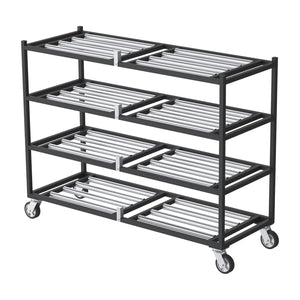
- Pull removable trays and clean the rails and supports.
- Clean the floor seams and the area under fixed racks.
- Disinfect, keep surfaces wet for the labeled contact time, then dry before reloading.
- Never mix bleach with ammonia or other cleaners (CDC). Bleach mixed with acids releases chlorine gas (Washington State Department of Health).
For a full routine, see Maintaining and Cleaning Your Mortuary Cooler. Damaged trays or racks are hard to clean well. Compare replacements in mortuary cooler racks.
Clogged drains and drain pans
The evaporator removes moisture from the air, and that water drains out through a pan and drain line. If the line clogs, water backs up into the pan or onto the floor and starts to smell musty. Signs include standing water under the evaporator, ice building in the pan, or water dripping from the unit.
- Turn off power before working near the evaporator.
- Clean the drain pan and confirm water flows freely to the drain.
- In freezers, check the drain line heater, because a frozen line blocks drainage.
- Do not pour harsh drain chemicals into the line without checking with the equipment manufacturer.
Replacement components are listed in cooler drain parts. Some self-contained upright units do not use a drain line, so check your model's documentation first. Facilities in humid climates should also read managing condensate in high humidity and condensation in mortuary facilities. Watch the 3-Body Standard Upright Mortuary Cooler video on our YouTube channel.
Mold and biofilm on the evaporator
EPA states plainly that the key to mold control is moisture control, and that mold cleanup must be paired with fixing the water problem or it will return (EPA mold guide). In a cooler, moisture collects on the evaporator coil, in the fan housing and around door gaskets. Dark or pink discoloration in these areas, or a musty smell when the fans run, means the evaporator needs cleaning. Coil cleaning involves fins and electrical parts, so it is a job for a refrigeration technician using the manufacturer's procedure. Coils, fan motors and blades can be sourced through our cooler coils and fan motors collections.
Worn door gaskets
A torn, flattened or hard gasket lets warm, humid air into the box. That raises humidity and makes the cooler work harder, and the gasket itself collects residue in its folds. Look for frost or sweating around the door, gaps you can see light through, and a door that does not close firmly on its own.
- Clean gasket folds as part of every cleaning.
- Replace gaskets that are torn, flattened or no longer seal. See cooler door gaskets and our door gasket replacement guide.
- For walk-ins with frequent door openings, strip doors can reduce warm air entry.
Controller, sensor or refrigeration faults
If the cooler cannot hold temperature after cleaning, the fault is in the equipment. Common causes include a failed sensor reporting the wrong temperature, a controller fault, a fan that has stopped, a low refrigerant charge or a failing compressor. Move remains to backup cold storage if the temperature keeps rising, and call a refrigeration technician. Replacement controllers and temperature sensors are available for many systems. Model-specific help is in our mortuary cooler troubleshooting and repair guide.
Odor prevention schedule
| Task | How often |
|---|---|
| Record cooler temperature | Every shift |
| Inspect pouches, trays and floor for fluid | Daily |
| Clean and disinfect trays, rails and floor | Weekly and after any spill |
| Clean and inspect door gaskets | Weekly |
| Check drain pan and drain flow | Monthly |
| Evaporator coil, fan and refrigeration service | Per manufacturer, by a technician |
Frequently asked questions
Why does my morgue cooler smell even when it is empty?
Residue is usually left in tray rails, floor seams, gaskets or the drain pan. Clean and disinfect those areas, dry the box, and check whether the evaporator or drain is wet and dirty.
Is a smelly mortuary cooler a sign it is failing?
It can be. If odor increases along with temperature, the cooler may not be holding its setpoint. Confirm the temperature with a separate thermometer and call a technician if it keeps rising.
Can I use air fresheners or an ozone machine to fix it?
Fragrances only mask odor. EPA states that no federal agency has approved ozone generators for occupied spaces (EPA). Remove the source instead.
How often should a mortuary cooler be cleaned?
Inspect daily, clean trays and floors weekly, and clean immediately after any leak. Follow the manufacturer's schedule for evaporator and refrigeration service.
When it is time to upgrade
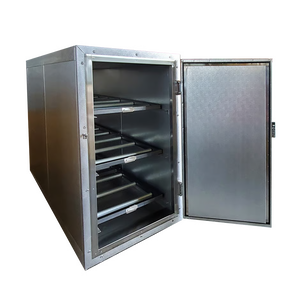
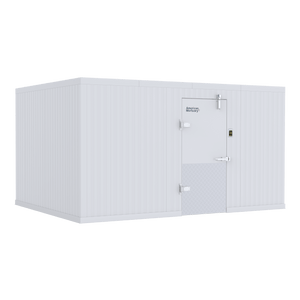
An older cooler that cannot hold temperature, has damaged interior surfaces or is too small for your caseload will keep causing odor problems. Compare walk-in mortuary coolers, upright mortuary coolers and roll-in mortuary coolers, or request a quote. Call 1-888-792-9315 or email cool@mymortuarycooler.com.
This guide is general operational information, not legal or service advice. Follow your equipment manufacturer's instructions and use a qualified refrigeration technician for electrical and refrigeration work.
Resources & Related Videos
Product videos
- 3-Body Standard Upright Mortuary Cooler | American Mortuary Coolers (YouTube, AMERICAN MORTUARY EQUIPMENT™) — view the product
- 2 Body Mortuary Cooler AMC Model #2BR (YouTube, AMERICAN MORTUARY EQUIPMENT™) — view the product
- 4 Body Oversized Mortuary Cooler with Interior Rolling Rack Model# 4BX (YouTube, AMERICAN MORTUARY EQUIPMENT™) — view the product
Related products
- 2 Body Standard Roll-In Mortuary Cooler – Model 2BR — $7,414.11
- 3 Body Upright Mortuary Cooler – Model 3B — $8,315.01
- 4-Body Extra-Wide Mortuary Refrigerator (4BX) — $9,107.01
See all videos on the AMERICAN MORTUARY EQUIPMENT™ YouTube channel
