



Decomposition Odor in Mortuary Coolers: Containment, Cleanup and Control

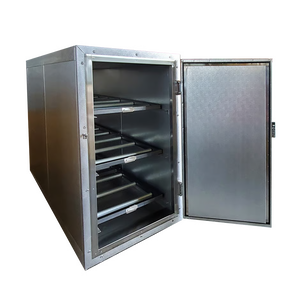
Decomposition odor in a mortuary cooler almost always has a physical source: a case that arrived with advanced decomposition, a pouch that leaked, fluid that reached a tray or floor seam, or a cooler that drifted warm. Refrigeration slows decomposition, but it does not stop it. Strong odor control comes from containing the remains, holding temperature, and cleaning the source. Air fresheners only cover it up. This guide covers how funeral homes, morgues, coroner offices and anatomy programs can manage decomposition odor in walk-in and upright mortuary coolers. Watch the 3-Body Standard Upright Mortuary Cooler video on our YouTube channel.
Key takeaways
- Cold storage is the main tool for slowing decomposition.
- Containment does more to control decomposition odor than anything else.
- When a cooler holds a mix of recent and decomposed remains, every door opening exposes the whole room.
- Fluid from decomposing remains should be handled as potentially infectious.
- Masking sprays add a scent over the odor without removing the source. Use them only after the source is cleaned.
If the odor is coming from the equipment rather than a case, start with our companion guide, Why Your Mortuary Cooler Smells and How to Fix It Fast.
Why decomposing remains smell
After death, the body's own enzymes and its bacteria begin breaking down tissue. A published review of decomposition odor research describes the result as a range of volatile organic compounds (VOCs) whose makeup changes with time, temperature, conditions and the microorganisms present (The smell of death, PMC review). One laboratory study of 6 human and 26 animal remains identified 452 compounds over six months, including sulfur compounds such as hydrogen sulfide, methanethiol and several disulfides (PLOS ONE). Dimethyl disulfide and dimethyl trisulfide are consistently detected around decomposing remains and are among the most odor-active compounds (2026 review of cadaver odorants).
Cadaverine and putrescine, the compounds most people associate with the smell of death, are described in the same review as primarily responsible for that distinct smell, even though they are not volatile organic compounds (The smell of death, PMC review). That matters for cleanup: once fluid reaches a surface, odor stays with the residue until it is physically removed.
For the stages behind this process, see The Stages of Human Decomposition Explained and Body Purge and Morgue Refrigerators.
Hold temperature first
Cold storage is the main tool for slowing decomposition. The World Health Organization's field manual for managing the dead calls refrigeration between 2°C and 4°C (about 36°F to 39°F) the best option, and notes that decomposition advances rapidly without cold storage (WHO field manual). State rules for funeral establishments vary. In Virginia, a body stored more than 48 hours before disposition must be refrigerated at no more than approximately 40°F or embalmed (Va. Code § 54.1-2811.1).
- Log cooler temperature on a fixed schedule so drift shows up before odor does.
- Keep doors closed and limit time with the door open during loading.
- Do not overload the box or block the evaporator airflow with racks or bags.
- Treat a sudden increase in odor as a possible temperature problem until you confirm the reading.
See Morgue Cooler Temperature Standards and State Regulations on Mortuary Coolers for setpoint and documentation detail.
Contain every case at intake
Containment does more to control decomposition odor than anything else. The same Virginia statute requires a funeral establishment to keep a body in its custody fully covered and in a manner that resists leakage or spillage, apart from embalming, preparation, dressing and viewing (Va. Code § 54.1-2811.1). WHO guidance also calls for each body to be kept in a body bag or wrapped before storage (WHO field manual).
- Use a pouch sized for the case. An undersized bag strains the zipper. Compare body bag sizes and zipper types before ordering.
- Choose heavier material for decomposed or leaking remains. Our body bags and disaster pouches include the 18 mil PVC 2XL disaster bag and chlorine-free options such as the Diamond heavy-duty oversize bag. For cremation cases, see why chlorine-free bags matter.
- Inspect the bag before it goes into the cooler. Check zipper closure, seams and the outside of the bag. Wipe and disinfect the exterior if it is soiled.
- Place absorbent material under seeping cases and set the case on a tray or rack position that keeps fluid off the floor and away from other remains.
- Label the case on the bag so staff can find it without unzipping it, which keeps odor contained.
Separate decomposed cases
When a cooler holds a mix of recent and decomposed remains, every door opening exposes the whole room. Wherever your layout allows, give decomposed cases their own position.
- Use the lowest tray or rack position for a leaking case so fluid cannot drip onto remains below.
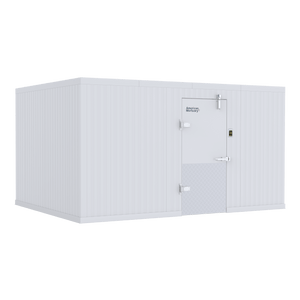
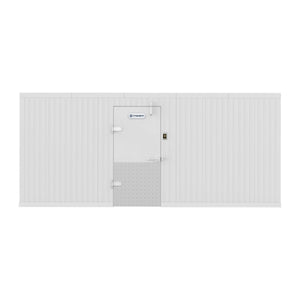
- In a walk-in, keep decomposed cases nearest the door and away from the evaporator fan, so air does not pull across them toward the rest of the room.
- Consider equipment with separate compartments. The 12-body triple-door mortuary refrigerator loads three bays through their own front doors, so one bay can be opened without opening the others.
- Schedule decomposed cases for disposition as early as your process allows, since cold only slows the process.
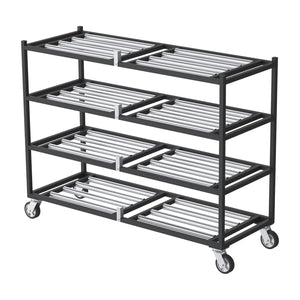
For capacity planning around these cases, compare walk-in mortuary coolers, upright mortuary coolers and mortuary cooler racks. For extended holds, review walk-in cooler vs. freezer vs. combo and our mortuary freezers.
Clean up after a leak or purge
Fluid from decomposing remains should be handled as potentially infectious. OSHA's Bloodborne Pathogens Standard requires contaminated work surfaces to be decontaminated with an appropriate disinfectant immediately or as soon as feasible after a spill, and requires employers to keep a written cleaning schedule and method (OSHA 29 CFR 1910.1030).
- Protect staff. Wear gloves, eye protection and fluid-resistant clothing. Follow your exposure control plan.
- Move remains out of the affected area and close any damaged pouch inside a new one.
- Absorb bulk fluid with disposable material and bag it as regulated waste under your state and local rules.
- Clean before you disinfect. Remove visible residue with detergent and water so the disinfectant reaches the surface, and follow the product label for pre-cleaning.
- Disinfect with an appropriate product and keep the surface wet for the labeled contact time. OSHA lists diluted household bleach and EPA-registered products such as tuberculocides as appropriate disinfectants, and notes that diluted bleach should be mixed fresh every 24 hours (OSHA hospital housekeeping eTool).
- Reach the hidden areas. Pull trays and racks. Clean tray rails, under racks, floor-to-wall seams, door sweeps and gaskets, where residue collects and keeps smelling.
- Dry the space before reloading, then record the cleanup in your log.
Never mix bleach with other cleaners. CDC advises never mixing household bleach with ammonia or any other cleaner (CDC bleach safety). Mixing bleach with an acid such as vinegar releases toxic chlorine gas, which is especially dangerous in an enclosed space like a cooler (Washington State Department of Health).
For routine, non-incident cleaning, follow Maintaining and Cleaning Your Mortuary Cooler.
Odor products: what helps and what to avoid
- Masking sprays add a scent over the odor without removing the source. Use them only after the source is cleaned. See choosing an odor neutralizer spray.
- Activated carbon filters can adsorb some odor gases. EPA notes that gas-phase filters target one or a limited number of pollutants and are not expected to remove all of them (EPA residential air cleaners summary). Replace media on the manufacturer's schedule and treat it as a supplement to cleaning.
- Ozone generators should not be used where people work. EPA states that no agency of the federal government has approved them for use in occupied spaces, and that ozone can cause health problems at high concentrations (EPA on ozone generators).
- Ventilation of the surrounding room matters, because odor released at the cooler door spreads into the building. Ask your facility engineer to confirm exhaust in the cooler anteroom or prep area.
Decomposition odor checklist
| Step | When | Why it matters |
|---|---|---|
| Log cooler temperature | Every shift | Drift speeds decomposition and odor |
| Inspect pouch and exterior | At intake | Stops leaks before they reach the cooler |
| Assign decomposed cases a low or separate position | At intake | Keeps fluid and odor away from other remains |
| Check trays and floor for fluid | Daily | Residue is the main lasting odor source |
| Clean, disinfect and dry after any spill | Immediately | OSHA requires prompt decontamination after spills |
| Inspect gaskets and door closure | Weekly | Poor seals let warm, humid air in |
| Replace carbon media | On schedule | Saturated media stops working |
Frequently asked questions
Does refrigeration stop decomposition smell?
No. Refrigeration slows decomposition, but the process continues at cooler temperatures. A properly held cooler with well-contained cases should have little odor, so persistent odor usually points to a leak, residue or a temperature problem.
What is the best temperature for a mortuary cooler?
WHO guidance recommends 2°C to 4°C (about 36°F to 39°F). Check your state's rule as well. Virginia, for example, sets a limit of approximately 40°F for bodies held more than 48 hours without embalming.
How do you get decomposition smell out of a cooler?
Remove the source first: move remains, absorb fluid, clean with detergent, disinfect for the labeled contact time, and clean hidden areas such as tray rails, seams, gaskets and drains. Then dry the space. Odor that returns after a full cleaning usually means residue was missed or the cooler is not holding temperature.
Can I use an ozone machine in a morgue cooler?
EPA states that no federal agency has approved ozone generators for occupied spaces, and ozone can cause health problems at high concentrations. Cleaning the source and good ventilation are the safer approach.
Should decomposed remains be stored separately?
Where possible, yes. A low or separate position, or a separate compartment, keeps fluid and odor away from other remains and limits exposure each time the door opens.
Plan your cooler around real caseloads
Choose a cooler sized for your full caseload, including decomposed and bariatric cases, so you are never forced to overload a box. Browse mortuary coolers, bariatric mortuary coolers and hospital morgue equipment, or request a quote. Questions? Call 1-888-792-9315 or email cool@mymortuarycooler.com.
This guide is general operational information, not legal or medical advice. Follow your state regulations, your exposure control plan and the instructions on the products you use.
Resources & Related Videos
Product videos
- 3-Body Standard Upright Mortuary Cooler | American Mortuary Coolers (YouTube, AMERICAN MORTUARY EQUIPMENT™) — view the product
- 2 Body Mortuary Cooler AMC Model #2BR (YouTube, AMERICAN MORTUARY EQUIPMENT™) — view the product
- 4 Body Oversized Mortuary Cooler with Interior Rolling Rack Model# 4BX (YouTube, AMERICAN MORTUARY EQUIPMENT™) — view the product
Related products
- 2 Body Standard Roll-In Mortuary Cooler – Model 2BR — $7,414.11
- 3 Body Upright Mortuary Cooler – Model 3B — $8,315.01
- 4-Body Extra-Wide Mortuary Refrigerator (4BX) — $9,107.01
See all videos on the AMERICAN MORTUARY EQUIPMENT™ YouTube channel
