

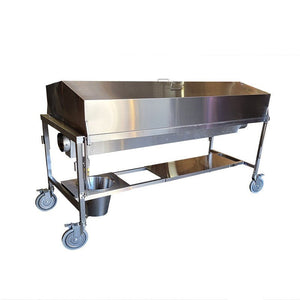
How to Choose a Mortuary Cot: The Complete First Call Guide
How to Choose a Mortuary Cot: The Complete First Call Guide
By American Mortuary Coolers — updated 2026
Choosing the right mortuary cot is one of the most important equipment decisions a funeral home makes. The wrong cot creates safety risks for staff, limits the types of removals you can handle, and wears out faster under daily first call demands. This guide walks you through every factor that matters — weight capacity, height adjustment, powered vs. manual, compliance, and total cost of ownership — so you can make a confident, informed purchase from a manufacturer you can trust.
Step 1: Define Your First Call Environment
Before you compare cot models, document where your removals actually happen. The three most common first call environments each have different equipment demands:
- Residential homes: Narrow hallways and staircases require a compact, maneuverable cot. Consider the PRO Model 500 or a slider board as an accessory for tight corners.
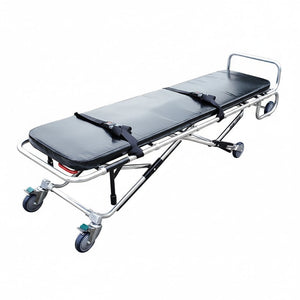
- Hospitals and nursing facilities: Wide corridors and loading docks allow larger cots with multi-level adjustment. The PRO 650X Multi-Level Mortuary Cot is ideal here.
- Outdoor and scene calls: Terrain variability demands rugged caster systems and a stable, rigid frame. Look for heavy-gauge aluminum or steel construction with locking casters.
Most funeral homes handle all three environments. Your primary cot should be the most versatile — then supplement with specialized equipment like slider boards and body bags from our complete collection.
Step 2: Set Your Weight Capacity Requirement
Weight capacity is non-negotiable. Exceeding a cot's rated limit risks catastrophic failure, staff injury, and liability exposure. The national average adult weight continues to rise — OSHA guidance and industry best practices industry best practices recommend sizing up, not to the minimum.
- Standard capacity (up to 700 lbs): Suitable for the majority of residential and nursing home calls.
- Heavy-duty (700–1,000 lbs): Recommended for general-purpose fleets where bariatric cases occur.
- Bariatric rated (1,000+ lbs): Required if you accept bariatric removal contracts. The PRO 1000X and Powered PMC1 cover this range.
Step 3: Evaluate Height Adjustment and Ergonomics
Mortuary cots with multi-level height adjustment protect your staff from back injuries — the leading cause of workers' compensation claims in funeral service. Compare these adjustment types:
- Fixed height: Lower cost but limited ergonomic benefit. Only appropriate for operations with very specific, consistent transfer scenarios.
- Manual multi-level: Foot-lever or hand-crank adjustment allows matching height to bed, gurney, or floor level. The PRO 650X Multi-Level is the benchmark here.
- Powered (electric): One-button height control. Maximum staff protection. See the Powered Mortuary Stretcher PMC1 for electric options.
Step 4: Verify OSHA and Compliance Standards
All mortuary cots used in professional funeral service should meet OSHA's bloodborne pathogen and ergonomic lifting standards (29 CFR 1910.1030 and 1910.900). Look for cots with:
- Non-porous, disinfectant-compatible surface materials
- OSHA-compliant weight ratings and safety labels
- Frame construction that resists biohazard fluid penetration
- UL/NSF listing where applicable
American Mortuary Coolers products are OSHA compliant, BBB A+ rated, and sold direct as a verified NFDA 2026 Supplier.
Step 5: Calculate Total Cost of Ownership
The purchase price is just the starting point. Factor in:
- Warranty coverage — AMC cots include manufacturer warranty. Used cots carry no warranty.
- Maintenance costs — Inspect quarterly, lubricate joints, replace casters as needed.
- Financing availability — AMC offers financing options to spread costs over time.
- Staff injury risk — A powered or multi-level cot that costs more upfront can save tens of thousands in workers' comp claims over its life.
Ready to find the right cot for your funeral home? Browse the full mortuary cots collection or call 1-888-792-9315 to speak with a specialist.
Frequently Asked Questions
What is a first call mortuary cot?
A first call mortuary cot is the specialized transport equipment used by funeral professionals to remove a deceased person from the place of death to the funeral home. It must be durable, height-adjustable, and easy to maneuver in tight spaces.
What weight capacity do I need for a mortuary cot?
Most standard operations require a cot rated for at least 700 lbs. For bariatric cases, look for models rated 1,000 lbs or higher, such as the PRO 1000X or Powered PMC1 from American Mortuary Coolers.
Should I choose a manual or powered mortuary cot?
Manual cots work well for lower-volume operations. Powered electric cots reduce staff strain significantly for high-volume funeral homes or frequent bariatric transport — see our collection at mymortuarycooler.com/collections/mortuary-cots.
How many mortuary cots does a funeral home need?
A general rule is one cot per removal team, plus a backup. A two-team funeral home typically operates with three cots. Volume, geography, and simultaneous call frequency all affect the right number.
Can I finance a mortuary cot purchase?
Yes. American Mortuary Coolers offers financing options for qualified buyers. Visit our financing page or call 1-888-792-9315 to learn more.
Are mortuary cots the same as hospital stretchers?
No. Mortuary cots are purpose-built for body transport, with different weight distribution, surface materials, and biohazard-resistant construction compared to hospital stretchers.
140 Kwick Way Lane, Johnson City, TN 37615
Phone: 1-888-792-9315 | Email: sales@mymortuarycooler.com
Mortuary Cots | Morgue Coolers | Financing | Contact Us | FAQ

