



Facility equipment · Family-owned · Quote only
Medical examiner office equipment
Plan the complete medical examiner workflow, from receiving and refrigerated storage to transfer, examination and cleanup. Organize the equipment by room and task so tables, sinks, carriers, racks, casework and supplies are reviewed as one connected project.

Project photographs
Installed stainless steel casework
Sink cabinets, open knee space and glass-front storage, photographed in the room.


Receiving, identification and body storage
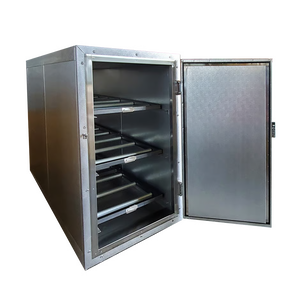
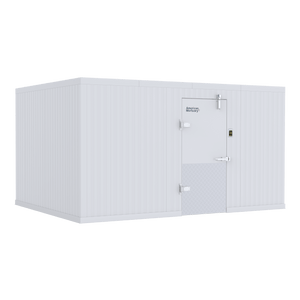
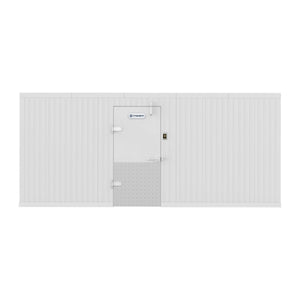
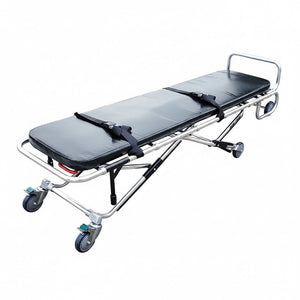
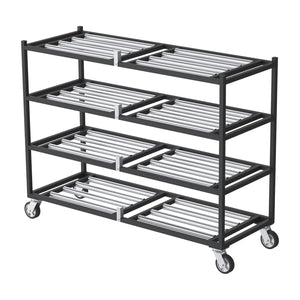
Document routine and peak receiving needs, body dimensions, door openings and the route from vehicle to storage. Identify the requested refrigeration configuration, racks, trays, carriers, lifts and identification supplies separately. Review the dimensions and operating clearances of the complete handling path rather than assuming equipment is interchangeable.
Autopsy and forensic pathology rooms
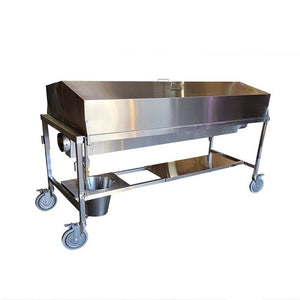
Start with the selected autopsy-table or trolley arrangement, sink position and operator access. Add grossing stations, saws, scales, instrument storage and cleaning supplies where the procedure requires them. State plumbing, electrical and exhaust interfaces for technical review; an equipment list is not an approved room design.
County, regional and state coordination
Use a distinct schedule for each facility and room, including any shared storage or examination service. County and regional medical examiner offices can separate immediate requirements from future expansion. State medical examiner organizations should identify headquarters and satellite responsibilities rather than duplicating every item in every location.
Support rooms, casework and recurring supplies
Coordinate custom stainless steel or powder-coated steel cabinets, shelves, sinks, water controls, PPE and exam gloves with the work performed in each room. Include replacement parts and required manuals for selected equipment. Keep human pathology equipment separate from veterinary and canine laboratory equipment.
Equipment across the medical examiner and coroner workflow
Follow each equipment family to the current catalog and native product pages. Identify selected models, quantities and options in the same request; listing an equipment family does not confirm suitability for a particular procedure.
Water controls and station connections
Begin water-service coordination with the USPE Hands-Free Water Control, then identify the selected Autopsy Station with Center Sink or other required station. Keep the Stainless Embalming Sink Station and Ventilated Wall-Mount Embalming Station specific to the procedure; embalming equipment is not automatically required in every medical examiner or coroner room.
A coordinated equipment RFQ
Room and equipment schedules
Send measured plans, selected model references, quantities, required options and delivery-site details. Identify utility, ventilation, structural and installation responsibilities separately from the supplied equipment.
Durability and service planning
Request the applicable construction details, loaded capacities, cleaning instructions, warranty terms and parts references for the selected models. For steel casework, identify substrate, finish, hardware and maintenance needs without assuming a universal service life.
Public-agency purchasing
Include bid instructions, required submittals, domestic-origin documentation and requested NAICS, UNSPSC, PSC/FSC, NIGP, SIC, CSI or HS/HTS classifications. Codes and American-made or domestic-preference requirements need review for the exact items and contract scope; no government endorsement or contract status is implied.
Family-owned and operated
Work with a family-owned, family-operated business on the equipment request. Keep the room plans and selected products together, with final configuration and inclusions documented in the written quote.
For a broader planning reference, the Office of Justice Programs' 1998 Forensic Laboratories facility-planning handbook discusses user needs, laboratory layouts and service coordination. It is historical guidance, not a current code standard or a USPE product approval.
Equipment planning questions
Does an agency name determine the equipment package?
No. Define the procedures, room responsibilities, selected models and required documentation. A sheriff's crime laboratory, coroner receiving facility and state medical examiner autopsy room have different operating requirements.
Can one request include equipment and recurring supplies?
Include both, with equipment models and options separated from glove sizes, PPE requirements and supply quantities. Final availability, fit, scope and purchasing requirements are reviewed for the written quote.
Does this page claim evidence-system certification or agency approval?
No. Any required security, chain-of-custody, laboratory performance or procurement qualification must be evaluated against the exact equipment and agency requirements.
